
Back in 2023, an article was published on this site about the supposed low point of Great Dane breeding in 2022, when only 663 puppies were born/registered in the two German VDH clubs (see link). Unfortunately, however, the situation has not stabilized or even improved; the downward spiral continues, and in 2025, only 414 Great Dane puppies were registered with the VDH! That is 75% less than 20 years ago! And 65% less than 10 years ago!
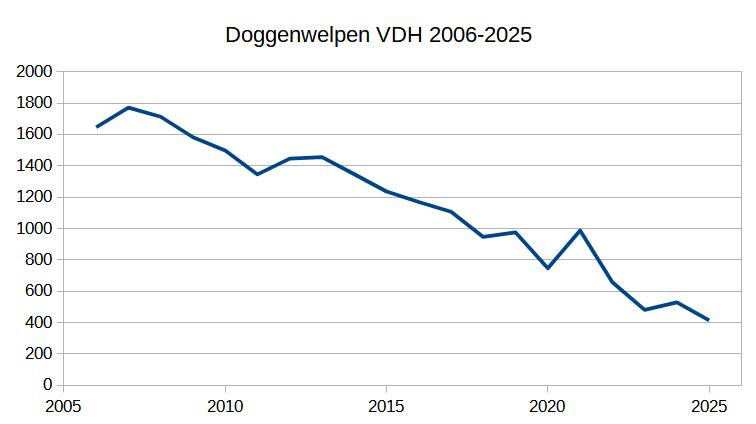
Great dane puppies registered in the German Kennel Club 2006-2025
According to the definition of the Red List of Threatened Species (IUCN), the Great Dane would be classified as “critically endangered.” Of course, the Great Dane is not a species, but rather a breed of the species Canis Lupus familiaris (wolf/domestic dog) that was artificially created by humans. But in terms of population development, comparisons can certainly be made here. A species is considered “critically endangered” if its population has declined by 50-70% in the last 10 years and/or if there are fewer than 2,500 reproductive individuals. In Europe, there are of course more than 2,500 Great Danes, but only a fraction of the sexually mature animals actually reproduce due to artificial selection by humans. As a result, the effective population size is significantly smaller than that of wild animal species, where most females and a high proportion of males have offspring, and is likely to be less than 2,500 worldwide.
The future of the Great Dane is therefore critical if the trend continues and no countermeasures are taken. It finds itself in a so-called “genetic bottleneck,” as was last the case during the two world wars. This means that the breed is rapidly losing genetic diversity, with all the associated medium- and long-term negative consequences of inbreeding depression, which include the spread of hereditary diseases, reduced resistance to negative environmental influences, reduced fertility, and behavioral problems.
The situation is particularly dramatic, as a very similar downward trend can be seen not only in Germany but also abroad. It is therefore crucial that both individual breeders and breeding associations become aware of this problem and take targeted countermeasures to preserve this wonderful, historic dog breed. And not just as an ailing relic presented at shows, but as a vital, physically and mentally healthy, four-legged member of the family.
The Situation in Germany
In the German VDH clubs DDC (German Great Dane Club) and KyDD (Cynological Society for German Great Danes), the number of puppies born/registered has declined significantly over the past 20 years, by 75% since 2006. The decline in the DDC, at 80% since 2006, is significantly higher than that in the KyDD, at 65% since 2006. In 2024, the KyDD even had a higher share of the puppy numbers than the DDC for the first time since the association was founded. This is because many breeders have migrated from the DDC to the KyDD in recent years, and because there are several large breeders in the KyDD with more than three litters per year.
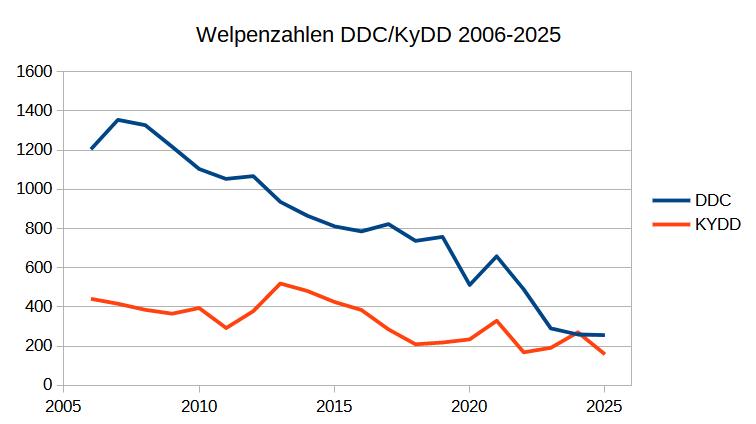
Number of registered puppies in the DDC and KyDD 2006-2025
Now, one could argue that the number of puppies for all breeds combined has fallen in the VDH. That is correct, but the decline in the VDH is only 35% since 2006, and for Great Danes in the VDH it is 75%. While the Great Dane was still among the 10 most popular dog breeds in the VDH in 2016 (and for many decades before that), it was only in 24th place in 2024 and even lower in 30th place in 2023 (the VDH’s puppy statistics for 2025 will not be published until later this year).
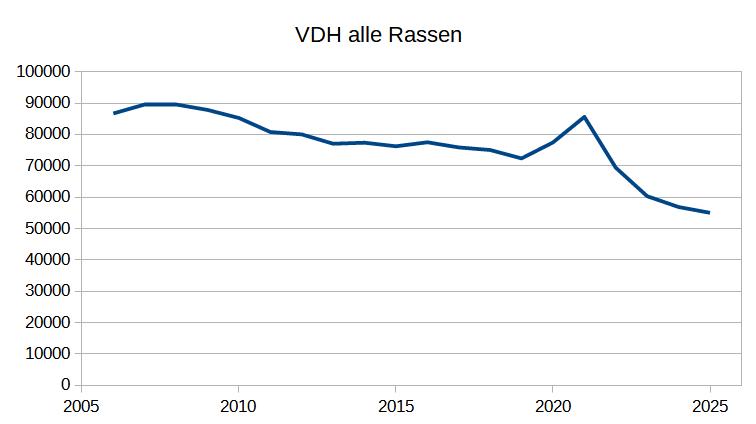
Registered puppies of all breed in the VDH (German Kennel Club) 2006-2025
The Situation in Austria and Switzerland
The situation for Great Danes is similarly dramatic in our southern neighboring countries. In 2025, just four litters with 25 puppies were registered with the SKG (Swiss Kennel Club) and three litters with 21 puppies with the Austrian Kennel Club (ÖKV). Unfortunately, the stud books of the two umbrella organizations have only been published digitally since 2011, so only the last 15 years can be considered. The decline in Great Dane puppies in Switzerland is 65% compared to 2011 (and as much as 75% compared to the record year of 2010 with 99 puppies). In 2025, 50% fewer Great Dane puppies were born in the ÖKV than in 2011. Since the total number of litters and breeders in both countries is low, the fluctuations in puppy numbers are naturally greater. However, a downward trend is definitely noticeable (apart from the Corona years, more on that later).
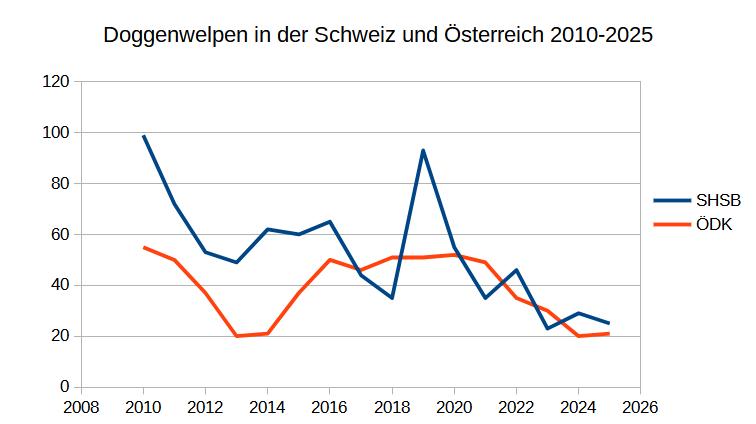
Great Dane puppies registered in Switzerland and Austria 2010-2025
If we look again at the registration figures for all breeds, we can see that in Switzerland (SKG) they have only fallen by around 20% (the figures for 2025 are estimates; they will not be published until later in the year) and in Austria (ÖKV) by around 10% (unfortunately, the Austrian dog breeding register has not been published since 2023 due to “trade and business secrets,” so the figures for 2023, 2024, and 2025 have been cautiously estimated based on developments in Germany, Switzerland, and Scandinavia, where a decline has also been expected since the Corona years).
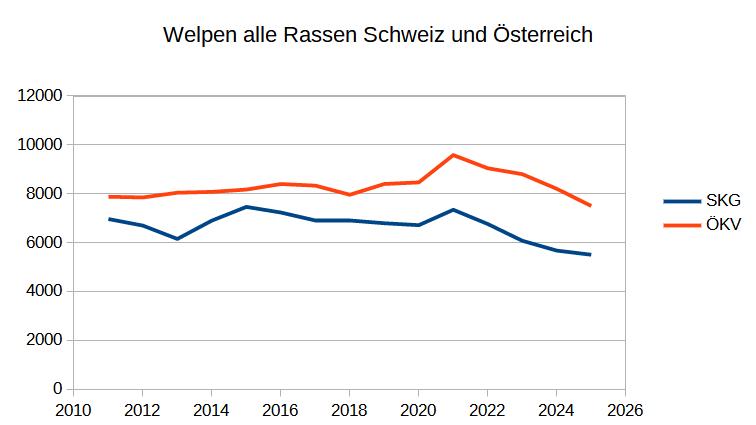
registrations all breeds in Switzerland (SKG) and Austria (ÖKV) 2011-2025
The Situation in Sweden and Finland
In these two Nordic countries, too, the number of registered Great Dane puppies has declined significantly over the past 20 years. In 2025, only 14 litters with 79 puppies were registered with the Swedish Kennel Club, while the Finnish Kennel Club (SK – Suomen Kennelliitto) registered 23 litters with 167 puppies. This represents a decline of almost 75% in Sweden compared to 2006 (with a peak in 2007, the decline was as high as 84%) and in Finland of 50% (compared to the peak in 2008, the decline was as high as almost 65%), although there appears to have been at least a slight stabilization in 2025 compared to the previous year 2024, with only 80 puppies registered.
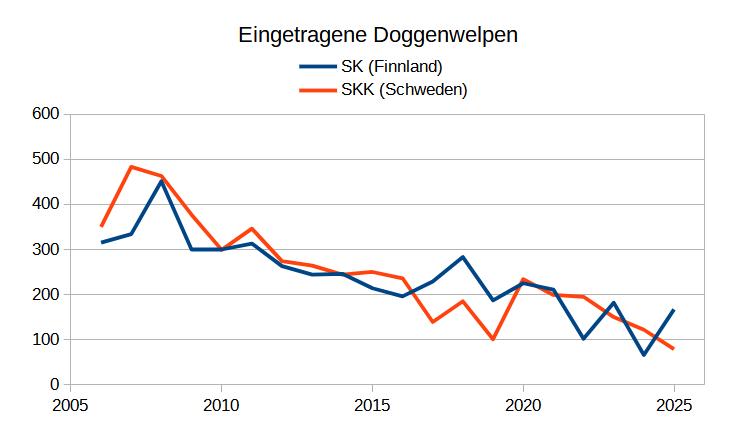
Registered great dane puppies in Finland and Sweden 2006-2025
Purebred dog breeding is much more deeply rooted in society in these two Nordic countries than in Central Europe. This is partly due to geography—it is much more difficult to transport “cheap puppies” and “rescued mixed breeds from Southern and Eastern Europe” to the far north, and border controls are strict. On the other hand, it is relatively easy for breeders to register puppies with the Swedish Kennel Club (SKK) and the Finnish Kennel Club (SK – Suomen Kennelliitto). Membership in a purebred dog breeding association is not required, there are no breeding licenses, and as long as the required health examinations have been performed, breeders can register the first two litters without an FCI kennel name. This also means that there is less competition from domestically produced puppies without pedigrees.
It is therefore not surprising that in Sweden, dogs with FCI pedigrees account for 70% of the total dog population in the country, and in Finland, this figure is as high as 80%. In both countries, almost 40,000 purebred dogs were registered with breeding associations in 2025. Remember, in Germany’s VDH, the figure was just 55,000! And Sweden has only 10.7 million inhabitants, Finland only 5.6 million. Converted to Germany’s population of 83.5 million, 320,000 puppies would have to be registered in the VDH compared to Sweden, and as many as 640,000 compared to Finland!
However, registration numbers have also declined in the Swedish and Finnish Kennel Clubs over the past 20 years, with the exception of the coronavirus spike that can be seen in all statistics. Since both breeding associations, especially the Finnish SK, have excellent online databases, all population statistics are easily accessible to the public. Compared to 2006, around 35% fewer purebred dogs were registered in Sweden in 2025, while in Finland the figure was just under 20% fewer. In these two countries, too, the decline in Great Dane puppies over the last 20 years is therefore far greater than the decline in registration numbers for all breeds.
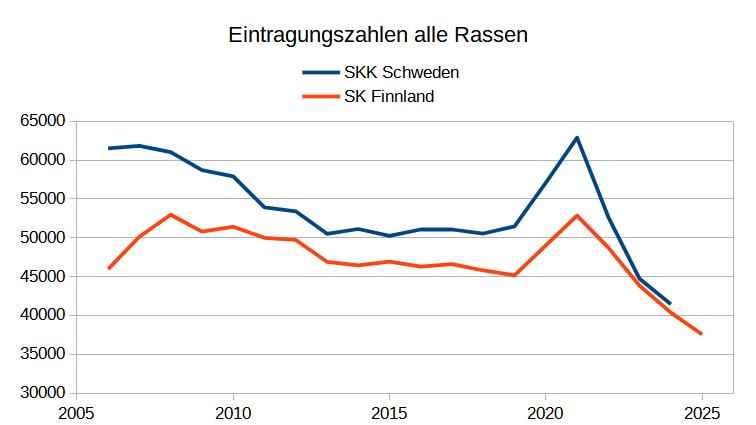
Registration numbers for all breeds in Sweden and Finland 2006-2025
Reasons for the Decline
Some reasons for the decline in the number of Great Dane puppies born/registered have already been mentioned in the previous chapters. The coronavirus peak is particularly striking. During the pandemic, many people had time to get a dog, and breeders responded to the increased demand. However, since 2023 at the latest, the trend has been declining again, the market is oversaturated, many dogs are being given away again, and animal shelters are overcrowded.
However, the number of registrations for both Great Dane puppies and puppies of all breeds has been declining for almost 20 years, at least in Germany. In Austria and Switzerland, the numbers for all breeds were relatively stable before the pandemic, albeit at a very low level. In Sweden and Finland, the declines are not quite as high as in Germany, and the proportion of the total dog population in the two Nordic countries is much higher than in Central Europe. The reasons for the sharp decline in the overall number of puppies in the VDH are, on the one hand, competition from “cheap puppies” born abroad, which can easily enter the country thanks to various internet platforms and a lack of border controls. On the other hand, there has been a trend in recent years to “rescue” mixed-breed dogs from southern and eastern European countries and import them en masse to wealthy countries in Central Europe.
Another reason for the overall weak support for purebred puppies bred in the FCI umbrella organizations in Germany, Austria, and Switzerland is the fact that these organizations make it very difficult for breeders to register puppies and are very closed off. Every breeder must be a member of a club that is responsible for their breed and obtains pedigrees through it (this has only recently been changed in Switzerland). The VDH is not an association for breeders, but for breeding clubs! Therefore, it does not feel responsible for individual breeders, who cannot become members!
There are two clubs for Great Danes in the VDH: the German Great Dane Club (DDC) and the Cynological Society for Great Danes (KyDD). Prospective breeders must therefore become members of one of these clubs before they can start breeding. Membership must be applied for and can be refused without giving reasons. It can also be terminated without giving reasons. It is also possible to obtain pedigrees from these clubs without membership in the DDC and KyDD by signing a corresponding contract. This option can also be denied without giving reasons. The fees for all club services are often more than twice as high for non-members!
In order to register a litter, the breeder must apply for an FCI kennel name, even if they only want to breed one litter with their bitch. This takes several months and costs several hundred euros. They must then attend a breeder seminar run by the relevant association and complete an inspection of the breeding facility. In order to breed with a Great Dane, it also needs an HD (DDC) or HD/ED X-ray (KyDD), and since last year, a heart ultrasound and a breeding license (exterior assessment by one or two judges from the respective purebred dog breeding club). There are also corresponding requirements for the respective breeding partner (male dog), and the DDC also has strict regulations regarding the use of foreign male dogs and color pairings.
The puppies are then inspected once, twice, or three times (depending on the club and litter size) by a breeding supervisor and only then receive a pedigree (in the DDC, a blood sample must also be taken from each puppy for proof of parentage).
Switzerland and Austria have similarly complex and strict requirements.
The respective breeder therefore faces many obstacles before they can even breed a litter and obtain pedigrees. Some of these steps depend on the individual decisions of a very small group of officials, which increases the risk of decisions being personal and subjective rather than factual and objective. It is therefore not surprising that in Germany, roughly as many Great Dane puppies are born outside the VDH (without papers or in dissident clubs) as within the VDH. Competition from “cheap puppies” from abroad is rather low for Great Danes, as breeding and keeping such large dogs is time-consuming and costly, and it is not a profitable trend breed.
The question is whether such a high level of bureaucracy and regulation in dog breeding—and Great Dane breeding in particular—makes sense, given that it has not exactly led to healthier, more stable, and more standard-compliant dogs in recent decades. Rather, this isolation on the part of the VDH and its member clubs seems to be partly to blame for the decline in puppy and breeder numbers. Furthermore, many health problems in purebred dog breeding—and the Great Dane is particularly affected here—have been hushed up by those responsible for many years, and no constructive solutions have been presented. In general, purebred dog breeding in Germany seems to have missed the boat somewhat when it comes to modernization. Only a few clubs offer their breeders modern databases, and the umbrella organization VDH does not offer any at all. The Nordic countries, especially Finland, are significantly further ahead in this respect!
As shown in the previous chapters, the decline in registered Great Dane puppies is more than twice as high as the decline in puppy numbers for all breeds. So there are reasons why people decide against buying or breeding Great Danes. The main reason is probably that the cost of living in general, but especially veterinary costs, have risen sharply in recent years. And the Great Dane is a breed that is expensive to maintain due to its size, but is also very prone to illness and very costly to breed. That is why many people tend to opt for small dog breeds, although medium-sized and large breeds such as the German Shepherd, Labrador, and Golden Retriever, as well as the German Wirehaired Pointer and Rottweiler, are still among the top ten in the VDH.
To put it colloquially: the Great Dane is “out.” “In” are constantly changing trend breeds such as poodles, dachshunds, French bulldogs, and the like, so-called designer dogs, i.e., mixtures of purebred dogs, usually in combination with poodles (Labradoodles, etc.), which are often sold for twice the price of purebred dogs and street dogs from abroad. The Great Dane has never been a trendy breed, and that’s a good thing, because this also has negative consequences. However, the drastic decline in the Great Dane population in Europe (and presumably worldwide) is worrying and threatens the future of the breed.
The Genetic Bottleneck
A genetic bottleneck refers to a drastic reduction in population size, leading to a sharp decline in genetic diversity and an increase in inbreeding. Even if a species/breed later recovers in terms of numbers, genetic variance remains low, which can result in reduced vitality and fertility (inbreeding depression).
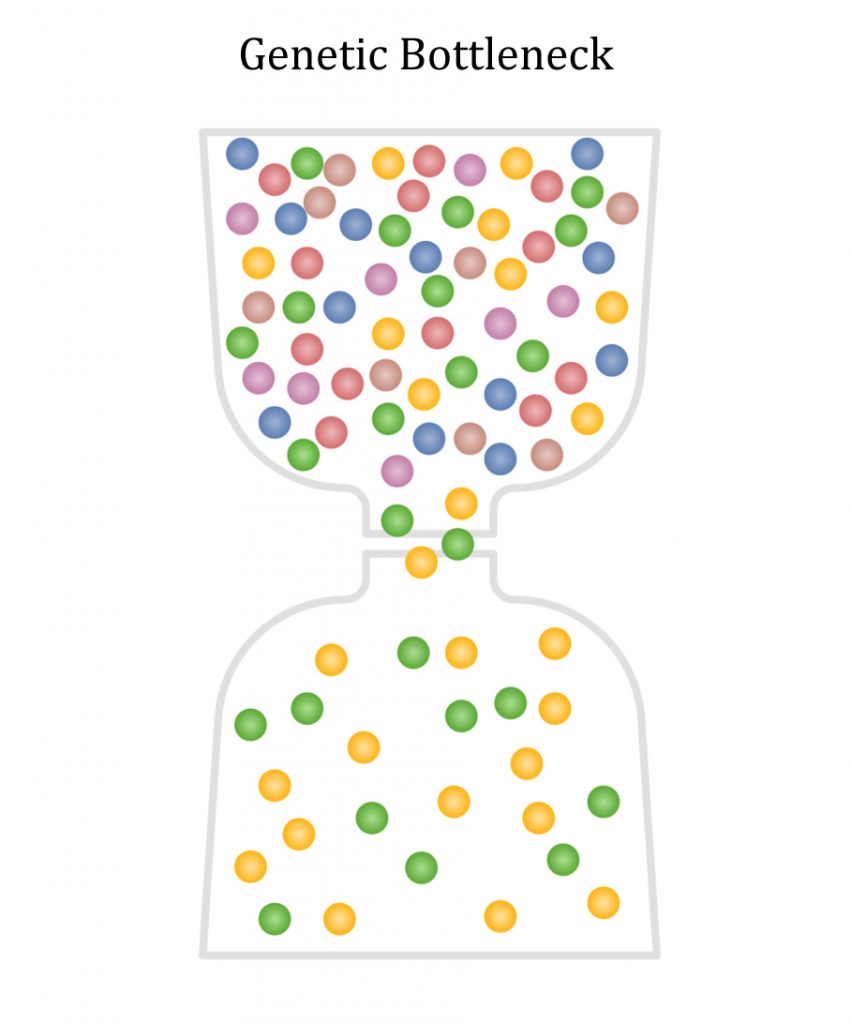
This is precisely the situation in which the Great Dane currently finds itself. And not for the first time. When the breed was first established (with the invention of closed stud books at the end of the 19th century), only a few individuals were selected for breeding, the so-called “founding animals.” Then, genetic diversity was further restricted by strong selection for a uniform phenotype (appearance), with only a few animals allowed to reproduce and individual males dominating breeding, which is still the case today (popular sire syndrome). Two further bottleneck situations were the First and Second World Wars, during which many Great Danes died/were lost and breeding in Europe had to be completely rebuilt. The division of the Great Dane into three separate color varieties has also further reduced genetic diversity within these three sub-breeds: yellow/brindle, black/spotted, and blue/black from blue.
As a result, the genetic diversity of Great Danes is already very low, even though litters with high inbreeding rates have become less common in recent years and the average inbreeding coefficient (IC) in many countries is around 2-3%. However, this is usually only calculated over a few generations. Genomic inbreeding (i.e., the actual, DNA-tested, not the calculated) in Great Danes is 27.2%, which corresponds to the degree of kinship between full siblings!
It is therefore not surprising that Great Danes already suffer from the typical symptoms of inbreeding depression. The average age of the breed is only 6.5 to 7 years, as many animals die from lethal diseases such as DCM, cancer, and stomach torsion long before reaching their maximum age (Great Danes can live up to 13 years, and in very rare cases even 14 years). Semi-lethal diseases such as wobbler syndrome, epilepsy, degenerative myopathy, etc. also severely impair the health of these dogs and often lead to early death by euthanasia. These diseases typical of Great Danes are genetically determined, and an accumulation of harmful genes leads to an increase in prevalence. On the other hand, low genetic diversity leads to a weakening of the immune system, making it more difficult to combat internal and external disruptive factors.
Added to this are fertility problems. The average litter size for Great Danes is only around 6.5 puppies per litter. As a giant breed, Great Danes can give birth to up to 20 puppies! The Finnish Kennel Club’s comprehensive database makes it easy to compare different breeds. Other giant breeds with high inbreeding rates, such as the Leonberger or the St. Bernard, have similarly poor scores to the Great Dane. However, large breeds such as the Rhodesian Ridgeback and the German Wirehaired Pointer have significantly more puppies per litter, a much higher average age and, interestingly, a lower IC. The Rhodesian Ridgeback is a relatively young breed, created from a mix of different breeds (including the Great Dane) and only officially recognized by the FCI (Federation Cynologique International) in 1955. The German Wirehaired Pointer is an old breed, but one that is bred primarily for performance. This is probably the reason why these two breeds appear to be less affected by inbreeding depression than the Great Dane.

Average litter size, life span and inbreeding coefficient in the Great Dane, Rhodesian Ridgeback and German Wirehaired
The litter size is calculated here based on the puppies entered in the stud books, not on the puppies actually born. Stillborn puppies, puppies euthanized due to deformities, and puppies that died in the first weeks of life are therefore not included. Unfortunately, most breeding clubs do not record and/or publish these important figures!
The Danesworld database records stillbirths that a few breeders voluntarily make public. In 2025, the rate was 4.5%. The actual number is much higher. Unfortunately, due to a lack of data, it is not possible to calculate statistically how many puppies die in the first few weeks and from what causes.
Complications during birth, such as cesarean sections, are also not recorded/published by the associations, even though this would also be very important information for breeding management! Here, too, Danesworld only has incomplete data from breeders who published cesarean sections. Last year, 25% of litters in the DDC were born by cesarean section, but the actual rate is likely to be much higher!
The percentage of successful matings is also relatively low for Great Danes, averaging only around 65%. This means that one-third of Great Dane bitches remain empty! These figures come from Germany, from DDC and KYDD, and were determined using the Danesworld database, based on mating and litter reports published by the clubs. Considering that most matings in Germany take place naturally, the rate should actually be over 85%. (Artificial insemination, especially with frozen semen, has lower rates, but is rarely used in DDC and KyDD).
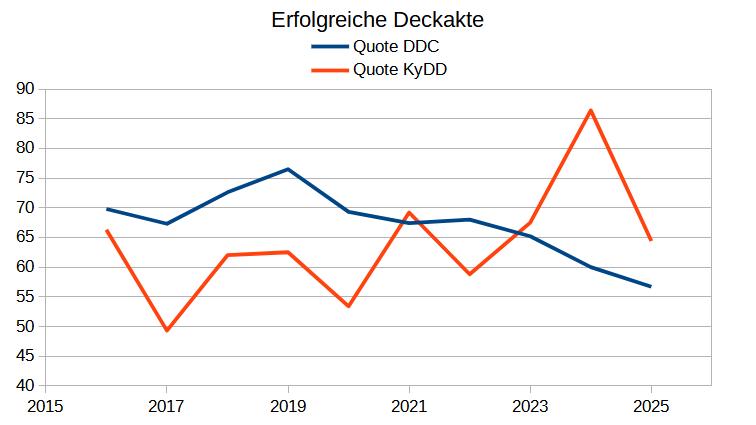
Percentage of successful matings in the DDC and KyDD 2016-2025
Counter Measures
The primary goal of breeders and breeding associations must be to preserve as much genetic diversity as possible for future generations. Even if the Great Dane population were to recover in terms of numbers, the loss of genetic variants is irreversible in a closed population. Thus, even a population that appears to be large, i.e., with a high number of individuals, can be genetically impoverished.
The effective population size is crucial for maintaining genetic diversity. This consists of the males and females that reproduce and their ratio to each other. In Great Danes, on average only 10-20% of females have offspring and only a fraction of males. As a result, the effective population size is much smaller than the actual number of living individuals, which means that the genetic material of all animals not used for breeding is irretrievably lost! This so-called genetic drift is stronger the smaller the population size.
The goal must therefore be to ensure that as many different individuals as possible reproduce and that the ratio of males to females used for breeding is close to 1:1. Not only breeders and breeding clubs must play a role here, but private owners too! They must help to preserve the breed and not just be passive consumers! They can do this by allowing their males to be used for breeding and making their females available to breeders, for example in the form of breeding leases for one or two litters, or perhaps even producing a litter themselves.
It is also important that no “popular sires” are used, i.e., individual males should not have an excessive number of offspring. Instead, dogs with rare lines in their pedigrees should be used. Repeat litters must also be taboo, as must litters with a high degree of inbreeding, as these lead to genetically very similar animals. A good way to preserve genetic diversity is to freeze semen. It can basically be used indefinitely. As many male dog owners as possible should take advantage of this option so that a gene pool can be created in the form of a sperm bank. However, it is also important here that the frozen semen is not used to allow popular sires to continue to have an excessive number of offspring even after their death!
There are three distinct color varieties of Great Dane and regional populations worldwide. Mixing these to increase genetic diversity within the respective populations and within the respective color varieties makes sense and is recommended by the FCI and already practiced by some progressive breeders. However, this does not change anything for the global population of Great Danes of all color varieties. As already mentioned several times, in a closed population, gene variants are always lost and new ones are never added (except through rare mutations, which usually have negative effects).
Therefore, consideration must also be given to opening the stud books in order to introduce new gene variants into the population and compensate for the loss of genetic diversity over the last 150 years. There are various options for doing this, which the Swedish Kennel Club has summarized well in its brochure “Lathund för genetisk variation” (Guide to Genetic Variation). For example, the stud book for Great Danes can be opened to dogs that do not have an FCI pedigree or any proof of ancestry at all. Phenotype assessment and DNA testing can be used to determine purebred status (although some foreign blood would be desirable). Especially in countries such as Germany, where almost half of the Great Dane population has pedigrees from so-called dissident clubs or no papers at all, this would be a good way to bring back gene variants that have been lost to the FCI population. In Germany and Austria, it would also make sense to facilitate the registration of litters in the VDH and ÖDK! Various categories of pedigrees/seals of approval would be conceivable, for example.
Opening up the stud books even further would also include the registration of Great Dane mixes. A further step would be a crossbreeding program, i.e., suitable breeds are specifically crossbred within a long-term breeding program. It is, of course, important that these breeds are compatible with the Great Dane in terms of character and phenotype, but at the same time do not carry the same common hereditary diseases or introduce other harmful genes into the population. In addition, such a project must be scientifically monitored and continuously ongoing, as the one-time crossbreeding of an individual of another breed is of very little benefit. In Scandinavia and other European countries, there are already a number of promising projects for various dog breeds. Ultimately, this is the future of modern purebred dog breeding, because consumers want healthy dogs with stable temperaments above all else and are willing to forgive minor phenotypic “flaws.” However, the deviations will be minor, because after just three generations, an F3 mixed breed will only have 12.5% foreign blood and will be almost indistinguishable from a purebred dog. In livestock breeding, the mixing of breeds is an integral part of the process, as it results in high-performance hybrid breeds.
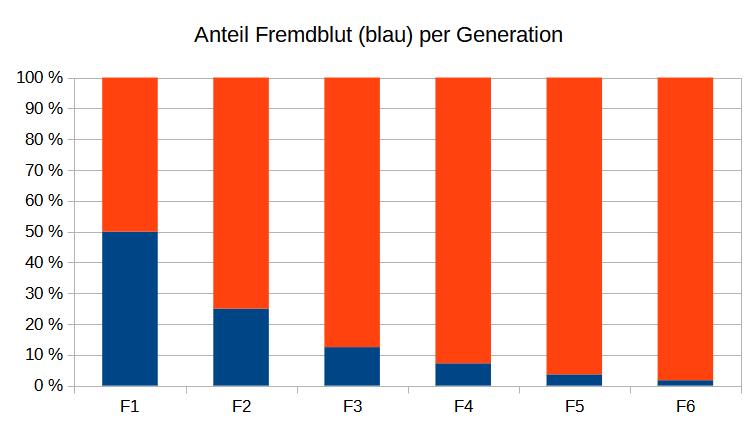
Percentage of blood from a donor breed (blue) per generation
Sooner or later, even Great Danes will have to undergo a corresponding breeding program, even if many regressive breeders and breeding associations still consider this to be an unimaginable sacrilege. They fail to understand that this would also be an opportunity to increase the popularity of the breed, as it would become healthier and easier to care for, not least for the breeders themselves, who also suffer from the problems described above. The quality of a breed is not determined by quantity, but by progressive, sustainable breeding management. The genotype is decisive, not the phenotype! Breeding means selection. Selecting means choosing. But if selection is no longer possible because a breed is genetically impoverished and harmful genes are widespread, then targeted breeding is no longer possible either!
We are very interested in the registration numbers for great danes in the country you live in! Is there a similar downward trend as in the kennel clubs mentioned in this article? If you can help us please send an email to: info@gesunde-dogge.de
translated with the help of DeepL
References:
https://jalostus.kennelliitto.fi/
https://www.skk.se/om-skk/det-har-ar-skk/press/
https://hundar.skk.se/avelsdata/Initial.aspx
https://www.vdh.de/ueber-den-vdh/welpenstatistik/
https://gesunde-dogge.de/tiefpunkt-der-doggenzucht-in-deutschland
https://www.instituteofcaninebiology.org/
https://www.hsb-blendivet.de/de/samebank-und-deckzeitbestimmung.html